Tuesday, December 29, 2009

WineWhine # 14

January, 2010

Welcome Linda Henke of Antigonish, N.S., Ian MacGregor of Vancouver, B.C, and Sharon Cochran of Prince Albert, B.C. to the Whine.

On being disappointed: Most of you have had this experience. You are in a restaurant celebrating someone’s anniversary or birthday and you decide to splurge on a bottle of Cabernet Sauvignon from Napa. The waiter (a sommelier wouldn’t do this to you) pulls the cork and offers a small amount from this $ 65. bottle (worth about $ 27. in your local store). Your cheeks (the ones near your mouth) are drawn severely inward, all saliva disappears from your mouth and you wonder who put the used teabag in your glass.

An even worse experience (although less common) is when someone opens that very special bottle that had been saved for just the right occasion. After Christmas dinner my son brought out a bottle of ‘98 Chateau-Neuf-du-Pape that he had been saving for some years. When poured the tell-tale brown color and the translucent ring where the wine met the glass forewarned us that this wine was going to be a big disappointment.

In the first case the wine was way too young (naturally the restaurant’s wine list did not indicate the year). The tannins in the Cabernet had not had time to mellow sufficiently for the fruit flavors to sufficiently come through. In the second case, the wine had simply been cellared too long (Chateau-Neuf is best at about 6-7 years).

Yes, I am back to my constant theme of cellaring wine for just the right time. What follows are suggestions for avoiding wines that are either too young or too old.

On getting started: O.K. you are not prepared to hire a contractor to convert your basement guest room into a climate-controlled cave for 2500 bottles. You don’t need to. My suggestion is that you start with a 48 bottle cache. No cost, no work.

Find the coolest spot in your basement (perhaps this is the back of a closet against an uninsulated exterior wall). Pick up 4 cardboard boxes from your liqour store, lay them on their sides, and you are well on your way. Since you may not be able to see the labels without pulling out each bottle (and wine doesn’t like movement) you can stick a piece of masking tape at the cork end of the bottle and write the name and year of the wine on the tape.

Now, the real fun part is picking the 48 bottles to store. Why 48? If you average two years between purchase and opening and you replace the wines as they are drunk, you will be able to have a special bottle twice each month. The rest of the time you can continue to drink your inexpensive wines that won’t benefit from cellaring.
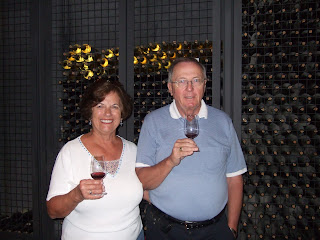
By the way, I have shown you a couple of photos of my cellar, but with the qualification that is usually found in Frank Magazine “NOT EXACTLY AS ILLUSTRATED”.

Suggestions on which wines to store?

1. Wines with lots of tannins benefit most from aging, so lay down the following varietals: Cabernet Sauvignon, Syrah/Shiraz, Zinfadel, Malbec, and Merlot. These have been listed from those that need the most time to those that need the least.

2. Wines costing more than $ 20. Most cheap wines do not benefit from aging. On the other hand, don’t buy really, really expensive wines. You may hesitate to open that really special bottle and keep it until it has passed its peak. Now, that’s a bigger tragedy than opening a wine that’s too young. I have several bottles of 15-20 year old wine in my cellar so if you want to see a grown man cry, come on over and watch me open a bottle of brown wine.

3. Buy wines from South America, California and France. The South American wines will not need to cellar as long as the others. This will help you get started. The good French wines will benefit from longer cellaring so don’t look to drink those next year. The Californian wines will also benefit from two or more years on their sides.

4. In one or two years select a bottle of Chilean or Argentinian wine (which will now be three or four years older than the year on the label). Try and buy a bottle of the exact same wine but which is two years younger. Open the two wines and you should be convinced about the value of your little cache.

Try something new: There are literally thousands of different varietals (grapes) that are grown to make wine. Yet, most of these are not widely marketed. Probably most of us drink only a half dozen different red wines. So, I am going to suggest you try something other than your usual Merlot, Shiraz, Zinfadel, or Pinot Noir.

The two varietals that I am suggesting are both from South America. They are neither light nor heavy, are inexpensive, go well with food; and, most importantly for some, they can be drunk quite young.

Carmenere: This grape variety originated in France and was used as a blending wine in Bordeaux. Unfortunately, the not infrequent September rains were not good for this late maturing grape. After the Phylloxera devastation in the 19th centurey, the French gave up on this wine and the only Carmenere now found in Europe is of very low quality and is grown in northern Italy.

In the 1850’s this grape was transported to Chile where it was widely planted. For some reason (perhaps because the vines looked similar) Carmenere and Merlot were interspersed in the vineyards and it was not until 1994 that DNA testing finally proved that the Chileans were growing Carmenere and not something mislabelled Chilean Merlot. Since 1994 the Chileans have put tremendous effort in producing good quality Carmenere and in fact it is the most widely grown grape in Chile.

The nose of this wine tends to be smoky and spicy and it has a taste that reminds me a bit of sour cherries. It pairs very nicely with barbecued beef (try it instead of Australian Shiraz). Is is less astringent than Cabernet which is why it can be drunk young.

Bonarda: If the Chileans claim their very own variety (Carmenere), the Argentinians claim two such varieties (Malbec and Bonarda). Bonarda originated in Italy and was probably transported to Argentina by the hordes of Italian immigrants who flocked to Buenos Aires in the 19th century to work in the meat-packing plants. As an aside you might find it surprising to know that more than 50% of the present population of Argentina is of Italian descent.

Sometimes this medium to heavy wine can taste a bit sharp, but it has lots of flavour and reminds me a bit of cranberry. It goes better with food than as a sipping wine.

Suggestions from Offering 192: This time I have four wines to recommend, two reds and two whites. Both reds are for immediate or almost immediate drinking and neither is very expensive. # 5355 is yet another fine wine from my favorite producer in Toro (Colegiata by Bodegas Farina) and should be wonderful with your favorite roasts. #5370 offers a blend of Tempranillo and Cabernet and should be a good, inexpensive quaffing wine. As usual I recommend the Vinho Verde (#5377) from Portugal. This cracking wine (sort of like a cross between a still wine and a sparkling wine) will make a great summer drink (assuming it reaches you by then). If you want 6 bottles of really great Chardonnay and if you are willing to cellar a white wine for a bit, order yourself a case of # 5400 Pouilly-Fuisse. It will be worth the exalted French price.

Link to article: Finally, thanks to Whiner Yvon Grenier who brought this article on British Claret to my attention:
www.economist.com/world/britain/displaystory.cfm?story_id=15108718

Sunday, November 22, 2009


WINE WHINE # 13
NOVEMBER, 2009

Welcome Chris Byrne and Jim Bickerton, both of Antigonish, to the Whine. Hope you enjoy at least some of the blurbs; and by the way, I love to hear from readers.

The third Thursday in November: If you go to your local wine shop in the near future you will probably see a large display with a sign boasting that “the 2009 Beaujolais Nouveau” has arrived. This is because Beaujolais Nouveau is released on the third Thursday in November. It is then rushed ‘round the world and wine merchants proudly lay claim to being the first to have bottles on their shelves. In Paris, restaurants compete to be the first to serve Beaujolais Nouveau to their diners.

The phenomenon of Beaujolais Nouveau is only about 40 years old and it is one of the world’s great marketing scams (thanks to Georges Dubeouf who got the ball rolling), because Beaujolais Nouveau is a truly dreadful wine. Tom Stevenson, the editor of Sotheby’s Wine Encyclopedia suggests that it smells like fingernail polish and tastes like bubblegum. Sometimes referred to as “lollipop” wine this slightly sour-tasting, watery liquid is produced and actually sold in humungous quantities.
If you don’t believe me resurrect one of your Halloween masks and go pick up a bottle. After you are certain that you weren’t recognized at the wine shop pop the cork and try the stuff for yourself. Better still, offer a glass to an unsuspecting guest, noting that you were first in line at the LCBO or the NSLC or wherever. Watch your guest desperately try to find something nice to say.

Now that I have warned you about Beaujolais Nouveau, let me say a word or two about other Beaujolais (see also the Whine for November, 2008). Beaujolais is a small region at the very south of Burgundy. The wine is made almost entirely from the Gamay grape. Beaujolais is a light, fruity wine that has a freshness to it. It should be drunk chilled (colder than you would drink other red wines) and is a great “starter” wine (that is the first wine of the evening). Not counting Beaujolais Nouveau (and it shouldn’t count for anything) there are 3 levels of Beaujolais. The first level is simply labelled Beaujolais, the second level is Beaujolais Villages (a blend from the 38 villages of the region). The very best Beaujolais comes from one of the individual villages (such as Brouilly, Chenas, Julienas, Morgon, Moulin-a-Vent or St. Amour). One of the nice things about Beaujolais is that it doesn’t need time in the cellar. This makes it a good choice to order in a restaurant that has only a modest quantity of wine on hand at any point in time, and which doesn’t attempt to age its wines (i.e. most Canadian restaurants).

“This wine contains sulfites”: Since all wines contain sulfites, this statement which appears on some bottles of North American wine is a tad silly. Sulfites occur naturally as a by-product of the yeast metabolism during fermentation. Sulfites (sulfur dioxide) are formed when sulfur reacts to oxygen. Thus the formation of sulfites reduces the amount of oxygen that is present in wine, and reduces the oxidation (rotting) of the wine itself. Some commercial wineries add sulfur when the wine is bottled and this allows the wine to age without going bad. I should also repeat that all wines naturally contain some sulfites, even those wines labelled organic.

You all have met someone who makes the following claim: “I can’t drink red wine because it gives me a headache; I’m allergic to sulfites you know.” It may be true that some people are allergic to sulfites. In fact humans can be allergic to almost anything (peanuts, shellfish, even their spouses on occasion). However, since white wine contains more sulfite than red wine, the above statement suggests either that the speaker has a psychosomatic allergy or is allergic to something other than sulfites.

There is an easy test for sulfite allergies. Since 2 oz. of dried apricots contains 10 times the sulfites that is in a glass of red wine simply eat a few dried apricots. If there is no headache then there is no allergy.

While it is quite unlikely that sulfites in wine cause headaches there are other possible causes of the so-called “red wine headache”. All wines contain various impurities, any of which could be allergenic for some people. However, cheap wines contain more impurities so it is quite possible that a bottle of Valpolicella can give you a headache and a bottle of well-aged Margaux does not.

Arguably the 3 greatest pleasures in life are sex, golf and good wine (not necessarily in that order). My advice is to serve and drink only good wine. It won’t lower your golf score but it may keep you from having a headache and it will perhaps improve your sex life.

Couldn’t finish the bottle eh?” Unfortunately most wine bottles contain 750ml. An exception is in this month’s Opimian Offering which has a number of 500 ml. bottles. Frequently, one would like a glass or two, but doesn’t want to drink 750 ml. For some of us 750 ml. is not quite enough and we would like one more small glass (this seems to be happening to me more often than not).

What do you do with the leftover wine? Air is the enemy of wine so once the bottle is opened the air rushes in to replace the poured wine and quickly oxidizes what’s left in the bottle. The solution, in theory at least, is to remove the air and reseal the bottle. Gerard recently sent me information on a new product that does just that. It’s called the Wine Keeper system and you can see it described on http://www.wikeeps.com/. After a thorough search of the web I concluded, unfortunately, that this product is not available in Canada.

So, what do you do? Since cool temperatures retards oxidation you should re-cork the bottle (saran wrap works just as well and is easier that trying to shove a swelled cork into the top of a bottle) and put the wine in your refrigerator. Unless the wine is a wonderful old vintage, in which case you’ll want to drink it right away, the wine should still be good for 24 – 48 hours.

You say Syrah, I say Shiraz”: Contrary to myth this wine did not develop in Persia, it is a purely French hybrid, the name of which, however, comes from the capital of Fars province in southwest Persia. Over time the French came to call it Syrah, but the Australians, went back to the original name Shiraz.

Australian shiraz is extremely popular in Canada and is a thick, heavy wine that can be best described as spicy. On the other hand, the same grape when grown in the much cooler climate of the northern Rhone valley has a very different taste. Although tannic when young the French version is less thick, less heavy, less spicy but very fruity and like most French wines quite subtle. After a long day yesterday of bathroom renovations Betty and I celebrated the end of the day with a bottle of Gilles Flatcher’s 2004 Saint Joseph (pure syrah). It was fabulous.

Opimian Special Offering 46: This is your chance to stock up on 500 ml bottles for those occasions when you want less than a regular-sized bottle. I would recommend #5289 a Chilean Cab/Merlot or #5291 an Australian Shiraz/Cabernet.

If you are willing to lay a wine down for a bit I recommend #5307 a Passetoutgrain from Bourgogne. Although the last time I had a bottle of this was on March 4, 2000, my notes tell me that I found it “extra smooth”.

Although expensive, you might want to add a case of #5309 Cote de Beaune-Villages to your shopping cart. Compare it to a Beaujolais Nouveau (trashed above) and see how the same grape can be both the best and the worst in wine.

Finally, if you or your guests like a glass of good brandy after that special meal, here is your chance to buy at a good price a case of Armagnac. If you like Cognac you will love Armagnac, which is sometimes confused with Cognac. However, the price is better and some would argue it has a more interesting taste and is perhaps even better than the better known Cognac.

Postscript: In preparing Whine # 12 my “spell-check” failed to distinguish between terroir and terror. Thus, one reader has visions of horrible monsters running up and down the rows of Mendoza’s best vineyards.


Tuesday, October 13, 2009


Wine Whine # 12 (October, 2009)

First let me welcome Leslie Thistle of Bangor, Maine to the Whine. Also, congratulations to Gerard Gleize on the birth of his grandson Oscar. I am certain that Gerard and Marie-Claude drank only Champagne to celebrate the arrival. Perhaps they will not be insulted if their Nova Scotian friends toast Oscar with a more affordable Cava.

This issue will have some comments on the best temperature for drinking wines, yet more thoughts on Argentinean Malbec, an answer to the question on how to choose Roses, a tale about drinking “Fake” Chablis in Nova Scotia. Finally, I shall make a few comments on Cellar Offering 191 from the Opimian Society.

Is your wine too warm? Many of us keep our white wines in the refrigerator and our red wines at the back of the kitchen counter. Thus, we drink our white wines chilled and our reds at room temperature. Not good enough to make your wines taste at their best. Perhaps in a later Whine I’ll let Gerard give a more sophisticated guide to wine temperature. In the meantime let me simply offer a Dummy’s guide to chilling or cooling wine.

First, your refrigerator is probably not cold enough for many white wines. Thus, if you are drinking sparkling wine or a good French Rose or even a Portuguese Vinho Verde you need to stick the bottle in an ice bucket. (Add some water to the ice cubes to get the best result). Perhaps a Californian Chardonnay can be drunk directly from your fridge.

The old adage that most red wines are to be drunk at room temperature fails to take into account that room temperatures of 21 or 22 (over 70 for you folks in the USA) is too warm for most reds. “Drinking wine at room temperature” dates back to the days when the Brits didn’t have central heating and they called their imported Bordeaux “clarets”. Very light wines such as Beaujolais are drunk best at 16 degrees or even cooler and most full-bodied reds such as Cabernet Sauvignon or Malbec are best at about 18 degrees. Too cold and you miss the subtle flavors. Too warm and the wines will taste alcoholic.

My cellar is a little cold and my son frequently complains that I serve my wine on the cold side (actually he says this in stronger prose). My response is that it is better to err on the cool side as the wine will warm quickly once brought to the table (especially if you hold the glass in your hot little fist).

If your wine is stored on the counter try this bit of advice. Put the bottle in the refrigerator for 20 minutes before uncorking. Don’t forget the order I’ve just indicated because if you pull the cork before you refrigerate your wine may taste like the road-kill casserole that you forgot to toss in the compost.

A couple of night’s ago Betty and I had a meal in one of our favorite pubs (Hilltop Grill and Beverage Room in Fredericton). This place has a reasonable selection of wines for a Maritime pub but the bottles are stored under the bar where the temperature is quite warm. I asked the waiter if I could have an ice bucket to cool our Malbec. No problem, she explained, “in here almost everyone asks to have their wine chilled.” So if the woman at the next table snickers at your bottle of red sticking out of an ice bucket, just smile and stifle any sharp retort. After all you are probably in a tavern and her boyfriend is no doubt both younger and bigger than you.

More on Malbec: The popularity of Argentinean Malbec seems to increase exponentially. In two recent visits to New England I found in several restaurants wine lists that featured inexpensive Malbecs. Leslie Thistle, Proprietor of a lovely wine shop in downtown Bangor told me that Malbec was her best seller.

In the last Whine I noted that FuZion was coming to Nova Scotia. It did and at $ 9.99 a bottle (compared to $ 7.45 a bottle in Ontario) it has sold out of each NSLC store. I have now tried this bargain wine so if you have access to it whip out a $ 10. and try it tonight. Also, if you are in a higher end shop (such as the Port of Wines in Halifax) try any of the wines by the Familia Zuccardi. FuZion is their bargain wine but for a “few dollars more” (sorry Clint Eastwood) you can pick up Zuccardi Zeta, Zuccardi Q or Zuccardi Santa Julia.

Argentinean wine is the current value wine for much of the world. Why? There are several reasons: (1) the Argentinean Peso is devalued; (2) the World is only now discovering the fantastic terror just east of the Andes; (3) Wine growers in Mendoza get very cheap immigrant labor from Peru and Equator. Will these wines continue to be bargains in 4 or 5 years? I really don’t know but there are some signs that they will not. For example the NSLC has started to import high end Malbecs ($ 40 and up) suggesting consumer willingness to pay a premium for the top Malbecs. Also, the laws of supply and demand (which have driven up the price of California Cabernets in the recent past) should also mean that we will have to look elsewhere in a few years for our bargains.

Picking a real Rose: Last time Gerard explained the process of making “real” Rose from only red grapes as opposed to making cheap and inferior wine by blending whites with reds. Buying a French Rose guarantees a certain quality. On the other hand, how do you avoid white and red blends when picking Roses from other places? This question was recently posed by a reader of the Whine. I think the answer is to read the label carefully. The varietals should be listed and if they are red grapes varietals you should be safe. So, for example, if it says that the Rose is a blend of Shiraz and Merlot, great. If the label says it’s a blend of the finest grapes from Upper East Backwater you can bet it’s a blend of white wine and red wine and that it will not please your palate.

A bad wine for Gerard and Marie-Claude’s anniversary: While visiting Nova Scotia Gerard and Marie-Claude celebrated their anniversary (I won’t reveal how many years but I think they were very young when they got married). Gerard wanted to go to a special restaurant. I suggested “La Fleur de Sel” which was about an hour’s drive from Summerville Beach where we were staying. The four of us had an excellent meal and the service was without reproach. As I was the designated driver I restricted myself to a couple of glasses of Cotes du Rhone. Gerard was excited to find a bottle of Leflaive Chablis on the wine list and ordered what should have been a very great burgundy with which to toast his bride (see picture of a pre-dinner toast). Throughout the meal he kept saying that the wine was not what it should have been and that it didn’t even taste like Chablis.


After their return to France Gerard did a little research and this is what he discovered: “The Leflaive family is one of the best wine makers in Burgundy with an international recognition from their Montrachets, Batard-Montrachets, and Puligny-Montrachets. To get a bottle from one of their wineries is not only expensive but very difficult. The problem is that a nephew, Olivier Leflaive usurps the family name and uses it to make his bad business. So I can tell you that the “Chablis” was no doubt imported in containers, bottled in Canada without the Leflaive name on the cork.” I wonder who is complicit with this fraud?

Cellar Offering 191: I usually make a few recommendations in each Whine for those of you who are members of the Opimian Society. This time, however, I have little to suggest. First I tend not to like South African wine and second I am drinking less and less Australian wine. Thus, I do not recognize very many of the wines offered and cannot therefore pass on much in the way of first hand experience.

If you do want to order a South African wine, you might consider one of the Pinotages (such as # 5219). Pinotage is hybrid developed in South Africa in 1925 (Pinot Noir and Cinsaut). Pinotage has a relatively unique taste and you might like to experiment.

Many of the Australian offerings are on the expensive side. On the other hand, I have tried the two Milyaroo’s (# 5255 and # 5256) and consider them to be good value at $14.33 per bottle. Finally, I suspect that # 5272 Meritage will be very good value as a Bordeaux-type blend.


Monday, July 27, 2009

August Whine

I decided not to wait for the next Opimian Offering (scheduled for October) before sending out another “Whine”. First, let me welcome Cheryl Hiscock of Moncton, John Miller of Toronto, and Karen Hill of West Chester, Pennsylvania to the distribution list.


Gerard in his cellar in Aix

This issue breaks new ground in that Gerard Gleize, of Aix-en-Provence, France will be making his first contribution. I first met Gerard on a golf course in Portugal in 1991. Although my golf game hasn’t improved in the past 18 years Gerard has managed to teach me a little about French wine during our many shared holidays in Europe and North America. Next week Gerard will be arriving for a holiday in Nova Scotia and during this visit I hope that I can teach him a little about the wines of Chile and Argentina.

Good News for Nova Scotians: In this week’s “Wood on Wine” columnist Sean Wood announced that Fuzion wines from Mendoza are soon to be carried by the Nova Scotia Liquor Commission. Those of you who live in Ontario already know of the phenomenal value of these wines. The Fuzion Red Blend is the single best selling wine in both Ontario and Quebec. I am told that workers in LCBO stores don’t even bother to shelve these wines; they just stack the cases next to the cash registers.

Wood and Tidings: I not only enjoy reading Sean Wood’s columns in the Chronicle Herald I also enjoy reading his articles in the wine magazine “Tidings”. In the last issue Sean wrote a very positive article about a Nova Scotian chef who runs a well-known restaurant in Wolfville. Let me start by saying that I ate there a couple of years ago and had a very good experience. Not so, however, when I took my sister for a birthday celebration last month. The four of us experienced bad food, terrible service and a wine list that must have been prepared by a “bait and switch” used car salesman.

To be fair the wine list had two sections, one of which indicated that the listed wines might be in short supply. I asked for one and was told they were out. I asked for a second and was told they were out. I asked for a third and was told they were out. I asked if they had any wines from that section and got a snarly response that I couldn’t decipher. I gave up and ordered a wine from the regular list. The waitress brought a bottle, but it was a different year than indicated on the list. I refused the wine and the waitress stormed away. Only after a lengthy interval and a lot of hand waving did she return. I ordered another wine from the regular list. When it came it also was a different year than listed. I gave up and drank the very mediocre wine.

Then, there was the food. My sister has dietary concerns and asked if one of the dishes could be prepared without the cheese-cooked spinach. “No, we only do it one way”, she was told, in an unpleasant tone. Betty and I both ordered the steak/frites medium rare. The steaks came medium, which would not have been such a problem, except they were served with fries so over-cooked that all the ends were black. Following very mediocre appetizers and even less than mediocre entrees we decided to forego dessert and look for an ice cream stand.

However, in case you are ever eating in Wolfville, you can get a very good meal at the other restaurant. It’s called Acton’s.

French versus Argentinian Malbec: Some of you may remember my attempt to do a blind-test comparison of a couple of Argentinian Malbecs against a couple of French wines from Cahors (the only wine from France which is predominantly Malbec). My methodology was less than perfect and left me with two possible interpretations, one that Argentinian wines were considered better (9 drinkers out of 10), or that my guests preferred to drink from Riedel cabernet glasses (8 out of 10). See the April “Whine” on how screw up your experimental methodolgy.

This, of course, all started when the NSLC indicated that they did not stock any Cahors because, they said, “ Nova Scotians prefer Malbecs from Argentina.”


Wines used in tasting

I challenged my readers to try the comparison and to report back. Four “Whine” readers from Toronto took me up on this and compared wines (see pictures of the labels) from Cahors and Mendoza. Here is what was reported:

The four of us sat down to eat, each with a glass on the left and a glass on the
right. We knew the wines that were being compared, but didn’t know in which
glass they were. We tried to not disclose our thinking until the end. Initial
observations were that they were almost indistinguishable, but as soon as we
started eating they became quite different. Everyone agreed that one had shrunk
to thinness and the other was seeming much heavier and flavorful. After the
meal, the wines became much closer again. 4 out of 4 were certain (and correct)
that the heavier wine was the malbec. 3 out of 4 (I dissented) thought it was
overall the better wine. No one seems to respect the subtlety of French
wines, although I admit that during the eating, the malbec held up better.
The most interesting thing was how much introducing food (I suppose, numbing
the sense of taste) changed the perception of the wines.


By the way, the menu was a mixed grill of chicken, rib eye, and veal sausage.

Gerard on Rose: This month Gerard Gleize tells us about a battle between French wine producers and technocrats from the European Commission. Reminds me of the fight a few years ago when the European Commission tried to force the French to pasteurize their cheese. Vive La France!!!

Here is Gerard’s tale: A Danish technocrat from the European Commission (the executive level of Europe’s 27 countries) in charge of agricultural questions decided to harmonize European legislation concerning rose wines.

First, let me say that there are two ways of making rose; one difficult and complex and one easy and cheap. The first method is described below. The second method simply mixes red wines with white wines. Actually, this is analogous to the two ways to make sparkling wine; the Methode Champagne (second fermenting in the bottle), or the short- cut method whereby carbon dioxide is simply pumped into bottles of white wine (Heikel Trocken anyone?)

Rose wines are fast developing popularity because they can be easily approached by new wine drinkers and also because they are easy, cool drinks on hot summer days. France is the # 1 producer of Rose in Europe (and most of those Roses come from Provence, which is my home.) It is forbidden to make Rose by blending red and white wines. Italy also makes Rose the hard way. Blending of red and white wines is considered a sacrilege.

On the other hand, the technocrat argued that importers of Rose (for example in China, India or Brazil) couldn’t tell good Rose from bad Rose (such as that produced in Australia and South Africa). In all probability she never saw a vineyard in her life and no doubt only drinks non-alcoholic beer. She did know a bit about marketing and argued that “if Europe wants to export to China, wine producers must be authorized to use the same methods as their competitors.”

But in France and Italy wine is not a product such as a camera or digital recorder. Wine, after all, has 2000 years of history and religious significance.

Real Rose is made only from red grapes. To get the Rose, the grower uses a special technique whereby the fermentation begins under very strict temperature conditions, similar to the temperature for fermenting white wine. The vintner watches very carefully and when the perfect color is achieved the liquid is bled away from the skins so that the color does not darken further. Fermentation continues and voila we have Rose.

At the beginning of the battle the French asked for specific labels for Rose in order to inform customers on the reality of what they were going to drink. Later the vintners lobbied to suppress the entire project. Aided by the Italian wine makers, the French vintners were successful in the lobbying efforts and the entire blending proposal was defeated. Now you can be assured the French and Italian Roses are real.

Monday, June 22, 2009

Wine Whine #10

SUMMER WHINE

It’s hard for me to believe that I have been writing this monthly “whine” for almost a year. It started by accident and as I have added names to the distribution list I have been having lots of fun expressing my own biases when it comes to choosing and drinking wines. Remember the choosing is as much fun as the drinking. This month I wish to welcome John Brough of Edmonton, Carol and Peter Fardy of Halifax, and Pat Fleming of Edmonton.

Recently one of my readers (who happens to be a very close relative) has been complaining about the antiquated format that I have been using for distribution. Not wishing to open attachments in principle (you know, those things potentially full of viruses) he insists that I start a blog and distribute the “whine” in that fashion. So, the next issue will be posted on a blog. However, recognizing that some of you are as technologically challenged as I am, next month’s issue will also be sent as an attachment.

Cellar Offering 190: My “whines” are always triggered by the appearance of a new offering from the Opimian Society. This month is no different. Offering 190 has wines from California and Canada as well as a few reprises from Spain and Italy. Most of you now know that my personal taste finds most Italian wines too acidic and most Canadian wines just plain awful. As there are only a few Spanish wines in Offering 190 I shall restrict my comments to the wines offered from California.

Arguably the best wines in the world come from California (sorry Gerard, but I had to say that at the risk of losing my only subscriber from France). Those of you who watched the recent movie “Bottleshock” know that Californian wines came to world attention in the 1970’s when a British wine merchant organized a blind tasting where the best of California was pitted against the best of France. For each pairing the experts chose the American wine and when the whole thing was repeated a few years later the Americans wines won again.

One of the five Californian vineyards that was chosen for the competition was the Steltzner Vineyards in Stag’s Leap, Napa. This month Opimian is offering four wines from Stag’s Leap. These wines are very expensive, but interesting for those of you are into a bit of history. By the way, I only ever tasted one bottle of Stag’s Leap and I was not overwhelmed.

Above I made reference to France versus California. Which country makes better wines? The question is really quite silly, it’s like saying “are fresh garden peas better than fresh garden beans?”; or “is rare prime rib better than medium rack of lamb?” If one could make a single statement about French wines it would be something like “they are generally light, soft, subtle and very complex.” On the other hand, wines from California are “big, bold, and full of fruit flavor.” The vintners work very hard to make their wines distinct and “New World” wines are not supposed to taste like “Old World wines” or vice versa.

Now I think the ultimate in “New World” wine is offered this month from Opimian. There are 7 wines from Reed Renaudin’s “X” Winery and Amicus. These wines are good, and the best is the Amicus, Special Blend (not to be confused with another great wine “Altimus” from Argentina). If, on the other hand, you are shocked at the price, continue on and look at the wines from Ironstone Vineyards. If there are any bargains in Californian wine, look here. In particular consider the Stone Valley Merlot for very good, everyday wine.

Reading a Californian Label: In some previous issues I wrote about reading Spanish wine labels and South American wine labels. This time I shall make a few comments about California labels. Firstly, unlike the strict appellation laws in France, Americans seem to be able to legally get away with almost anything. As such the information on a bottle of California wine is mostly just marketing bull. On the other hand, the wine will almost always identify the varietal (merlot, cabernet, etc.).

The task for the consumer is not in reading the lines on the back of the bottle but in reading between those lines. Here are some hints:

If there is only a brand on the front and some bullshit on the back such as “this wine matches well with barbeque steak, chicken and veal” it’s probably plonc.

“this wine is blended from some of the finest grapes in California”—this means the producer bought the leftover grapes from 47 growers and mixed them together to make really bad plonc.

“this wine is one of the finest wines produced in the Central Valley”—perhaps but few good wines come from the Central Valley

If the front of the bottle identifies the wine from Sonoma or Napa the wine will definitely be decent.

If the wine says it’s from the grower’s own estate you are in luck.

If the wine says it’s from a single vineyard, even better; but not as good as if the single vineyard is identified.

The Professional Sommelier: In an upscale restaurant you may luck out and find that you can order your wine from a sommelier, rather than from your waiter. While this may seem pretentious, it is not. Almost always the sommelier will know his (or her) wines, will give good advice, and the good news is that the sommelier doesn’t cost you anything. You tip the sommelier just as you would your waiter, but having your bill split between the waiter and the sommelier and adding a percentage tip adds to the same total.
If you are served by a sommelier, engage in a conversation. He will need to know what you are eating, how much you want to pay for your wine, and your overall taste preferences (such as do you like light or heavy wines). Just as your waiter will be able to tell you about how a dish is prepared, and what is particularly good tonight, the sommelier can tell you about the wine, how it tastes and if a particular wine is of essentially good value.

Betty and I recently spent 14 nights on the good ship Constellation. We had the same sommelier 12 of the nights and ate in “open seating” on the other two. The second night I ordered a “malbec” and Rodrigues (from Goa, where StFXers all know you can find the bones of St. Francis Xavier) looked at me and said “No, you will find this wine disappointing”. I ordered something else, but the first night we had “open seating” I ordered the malbec from a different sommelier. Guess what, the wine was awful and the only bottle of bad wine I had during the entire holiday. On another occasion I ordered a shiraz (actually one of Greg Norman’s). Rodrigues said: “If you will pay $ 5. more I can recommend something much better”. The extra $ 5. was very much worth it. Finally, I complained one night that there were no carmineres from Chile on the wine list. Not a problem for Rodrigues, he simply appeared with a great, yet inexpensive carminere.

Wine Whine #9

May Wine Whine

Welcome Edward Langille of Antigonish to the Whine.

For this month’s Whine I had hoped to pass on information on proper temperatures for serving wine. My very good friend Gerard Gleize of Aix-en-Provence sent me lots of tidbits on this subject. However, translation is taking a little longer than I expected; so maybe next time.

Drinking wine in hot weather: Most of us know that there are few pleasures greater than downing a chilled beer after being out in the hot sun. Golfers, for example, have been known to imitate mad dogs and Englishmen and go out at midday. Just as cold beer is best drunk on a hot day, heavy red wine is best with cool weather food, especially when paired with something succulent such as a rare roast of prime rib. So does this mean you should padlock your cellar between June and September?

A few years ago Betty and I were holidaying in Provence in the summer. At lunch (eaten ouside as you would expect) we noticed that we were the only people in the restaurant with a bottle of red wine. At supper (also eaten outside) we were again alone in our choice of beverage. So what were the locals drinking? Rose! Rose! Rose! Chilled rose can be a most magnificent alternative to a cold beer, when your body temperature demands a chilled drink.

In Canada, when many of us think of a pink wine, we think of that horrible stuff that was marketed not so many years ago. Surely you remember “Baby Duck” or some other really bad Canadian wine saturated with sugar. Well, there are wonderful pink wines that are not sweet and that are great in the summer. I think the best ones are from France, but then there are also good roses from Spain and from South America. Try one the next really hot day. Of course, if you really don’t like rose you can always drink sparking wine (not just Champagne from France, but Cava from Spain). Sparking wine is a great summer drink (but then it is also a great Spring, Fall and Winter drink)

Oddly, Canadian ice wine, is not really a summer drink. Ice wine, which is, of course, very, very sweet is not intended to quench a dry thirst. Ice wine is best served with heavier foods. While it is sometimes thought of as a dessert wine, ice wine is perfect before dinner, especially when paired with foie gras, or pate. But here’s a tip. Ice wine is very expensive. So if you don’t want to lay out $ 60 -$ 80. for a half bottle, try a bottle of “late harvest” wine, which sells for ¼ the price and to my palate is indistinguishable from ice wine. Why? In order to be called ice wine, the grapes must have been picked after 8 successive days when the daytime temperature was above freezing and the nightime temperature was below freezing. So what happens if the weather doesn’t co-operate and the grapes have to be picked after only 3 or 4 days of the regime. The stuff is sold as “late harvest” wine and at bargain prices.

Reading Spanish Wine Labels: Although wine has been made in Spain for millenia, quality control has only existed for 30 years or so. Prior to that Spain produced bulk wines. However, the terroir is such that Spain is capable of and does produce great wines, some of which even come at bargain prices.

On the label you will usually find the term “Denominacion de Origen” just under the name of one of the 60 wine zones. This is your guarantee of government controlled quality and is similar to the French “Appellation Controlee”. Wines without this designation should be avoided.

In addition to controlling quality through the name of the region Spain has an excellent system of classification by age. The poorest wines are bottled and sold with no time in casks. These “Joven” wines are to be drunk young. In Canada you will not find the term “Joven” very often but you will find the terms “Crianza”, “Reserva” and “Gran Reserva”. “Crianza” means the wine has been aged at least 24 months with 6 months in a cask; “Reserva” wines develop for 36 months with at least a year in an oak cask. Of course, the very best wines are “Gran Reservas” which have been in a cellar for at least five years and have been in an oak casks for at least 18 months. While many “Crianzas” are good, you will be assured of very good wine when it says “Reserva” and great wine when the label says “Gran Reserva”

Now look for the region. The biggest area in Spain is Rioja, but the best wines come from the Ribera del Duero. Most of these wines are made from the tempranillo grape, which has its own unique taste. When one thinks of Spanish wine one thinks of tempranillo. The wine will usually taste very dry and be more spicy than fruity.
Tempranillo is frequently blended with other Spanish grapes.

If you are a little more adventurous, may I suggest you also try the monastrell grape. Like tempranillo this grape is grown mostly in Spain. Monastrell tastes fruitier than tempranillo and is “bigger”, meaning you could confuse it for a New World wine. The best Monastrells come from Jumilla.

Cellar Offering 189: The last offering from Opimian listed the wines of Bordeaux. This offering has wines from the other important area (Burgundy) as well as from the also famous Loire Valley and from the South of France. World class cabernets and merlots come from Bordeaux; Burgundy is famous for Pinot Noirs and Syrahs. The Loire Valley is most know for its white wines. However, in some ways the most interesting wines are now from the South. At least, the best bargains in French wines are from Provencee and Languedoc-Roussilon. Growers are under fewer restrictions in the South and are able to experiment, including the making of bigger, bolder wines for the North American market.

I have 3 recommendations: First, you might consider # 5102 Pouilly Fume 2008 from Domaine Mollet-Maudry. Expensive but Sauvignon Blanc like you may never have tasted.

Since I pushed roses (above) I suggest that 5138 Grenache rose, Vine de Pays D’oc, 2008, Domaine Peiriere. Perhaps a real bargain.

My final recommendation is an absolute must. 5125 Chateau Salitis, AOC Cabardes, 2007 will be great. I bought a case of the 2005 which is just coming into its own. This blend of merlot, cabernet sauvignon, malbec, syrah and grenache will forever put to rest the myth that French wines are thin and weak. This stuff is fabulous.

An odd holiday: On Monday Betty and I are off to do something really strange. We are going on a holiday where there are no vineyards of importance and where we are not even bothering to take our golf clubs. Perhaps we have taken leave of our senses. However, we are told that we must see the Baltic States and St. Petersburg before we die, so we shall suffer through, the best we can, all the symptoms of wine and golf withdrawal. Wish us well!


.

Wine Whine #8

Wine Whine for April


Welcome Ed Pencer of Lanark to the “Whine”.

This month’s “Whine” is divided into three sections. First, I am going to tell you about an attempt to choose between Argentinian Malbecs and French Cots (the name for Malbec in the Cahors region of southeast France.) As someone who once taught a course in research methodology this story is a tad embarrassing.

Second, I am going to begin a series of “whines” about how to read labels. This subject is sufficiently complex that I am going to tackle only one or two countries at a time.

Finally, there are some comments on Opimian Cellar Offering # 188.

The Less than Perfect Evaluation

I mentioned in an earlier “Whine” that I was less than impressed with the Nova Scotia Liquor Commission’s refusal to stock wine from Cahors. The argument is that Cot or Malbec from Cahors is inferior to Malbec from Argentina and therefore if put on sale in Nova Scotia the wine would never leave the shelves.

While in Ontario recently I picked up a couple of bottles of Cahors (an ‘04 Chateau Haut Monplasisir at $ 17.95 and an ‘07 Croix du Mayre at $ 18.30). I decided to match the first French wine against an ‘05 Trapiche Broquel, picked up on sale for $ 11.88, and to match the second French wine against an ‘05 Don David Reserve, purchased for $ 16.79.

Now if you are bored with research methodology skip the rest of this. However, the moral of the story relates more to my errors in method than in my giving any real enlightenment on wine choice.

Thinking I was being quite clever, I pre-poured the Monplasisir and the Trapiche and passed two glasses to each of my 10 guests. The task for the guests was to select the preferred wine by indicating whether they liked the wine from the Riedel Cabernet glass, or the wine from the non-Riedel Burgundy glass. To control for the difference in the glasses half of the guinea pigs got the Cahors in the Cabernet glasses and the other half got the Trapiche in the Cabernet glasses.

When 5 guests chose the Cahors and 5 chose the Argentinian Malbec I thought I had determined that the two wines were of equal quality. Then I realized that 8 out of 10 picked the wine from the Cabernet glass, which of course was the more appropriate vessel for serving a tannic Malbec. Cabernet glasses are relatively high and narrow and shoot the wine to the back of the tongue where the bitter receptors are located.

O.K., having at least two interpretations of the results I then gave the second pair of wines to the guests. This time the guests poured their own wine into whatever glass they wished. Their only task was to indicate from which decanter came their preferred wine. This time, 10 out of 10 chose the Don David.

However, before I admit that the buyer from NSCL really knows his stuff I have to caution that this comparison may have been quite unfair as the Cahors was an ‘07 and perhaps not cellared sufficiently to mellow out the tannins.

By this time I was feeling so inadequate that I broke out the ’05 Trapiche Vina Francisco Oliva (an overall winner from last fall’s Halifax wine fair) and let my guests mellow out on one of the best wines from my cellar. After all, they deserved it.

South American Wine Labels

Nova Scotians buy a lot of wine from Chile and Argentina, mostly because these wines are of such good value. Argentina and Chile are the 5th and 10th largest producers of wine in the world. They are the 5th and 25th per capita consumers of wine. Canadians, on the other hand, are the 30th in terms of consumption and don’t even rate on the production side. One more bit of trivia. For every bottle of wine drunk by a Canadian, an Argentinian drinks three and a French person drinks five. Betty and I, of course, are doing our very best to raise the Canadian consumption average.

The question, however, is how do you choose a good wine when faced with a bewildering array of bottles at your local government store? Well, the short answer is to read the label carefully. The problem is that each country has a somewhat different system of labeling wine. France, for example, has very rigid laws which control what a wine can be called. Unfortunately, these laws are somewhat antiquated and are seemingly designed to make choice more rather than less difficult. I strongly believe that France wine exports would be rising (rather than currently declining) if they would only consult with me about what consumers on this side of the Atlantic need to see on the label. However, I’ll come back to this in later issues of the Whine.

The quality of a wine depends on lots of factors including the terroir (soil), the age of the vines, the climate, whether or not the vines have been overcropped, the skill of the vintner, the length of cellaring, and of course the varietal (kind of grape). Unlike Europeans, South American producers always prominently display the grape, including the percentages of each grape in a blended wine. Argentinians are best at big, fully flavored tannic wines. Thus, if choosing an Argentinian wine it’s almost impossible to go wrong with Malbec, and their Cabernet Sauvignons are also good. Chile, on the other hand, is the only country in the world to produce Carmenere. Chile is also very good with Cabernets. By the way Carmenere was a varietal grown in France until the phylloxera louse devastated European vineyards in the 19th century. Now varietals the world over are are grafted onto phylloxera-resistant roots. The only exception is in Chile where Cabernets vines are grown on Cabernet roots and Merlots on Merlot, etc. If you want to spend a very long time in a South American prison try smuggling a wine shoot across the Andes into Chile.

Chile and Argentina have copied the Spanish in labeling their better wines “reserva” and their best wines “gran reserva”. The difference is that in Spain these terms are controlled by the government and there are strict laws about how long the wines must be oak-barreled before these terms may go on the label. In South America the terms are left to the producer to decide when to use. Nonetheless, if the label says either “reserva” or “gran reserva” you will not be disappointed.

Like car manufacturers wine producers in South America give brand names to their wines. So, just as you know that a Honda Civic is a cheaper car than a Honda Accord, you can tell a lot by the name a wine producer uses. So, for example, the biggest producer in Chile (Concha y Toro) calls their poorest Frontera and the best wines Don Melchor.

What follows are some hints that will help you choose a South American wine. I am going to list some common wine producers (like saying Honda or Toyota). Then I’ll give a brand that is at least one up from the bottom (like saying Accord or Camray).
So, for example you will find lots of Carmen wines in Nova Scotia. However, if the wine is a Carmen Nativa that means it’s better than a plain old Carmen.


From Chile:

Carmen: Nativa
Baron Philippe de Rothschild Maipo Chile: Escudo Rojo
Caliterra: Caliterra Reserva
Canepa : Malbec Private Reserve
Casa Lapostolle : Cuvee Alexandre
Concha y Toro : Trio or Marques de Casa Concha (avoid Castilla del Diablo)
Luis Felipe Edwards : Reserva, Gran Reserva, or Pupillo
Miguel Torres Chile: Don Miquel
Montes: Alpha
Santa Rita : Casa Real
Villard Estate : Expresion

From Argentina :

Etchart : Etchart Cafayate
Finca Las Moras : Reserve or Andean
J & F Lurton : Gran Lurton or Piedra Negra
La Rosa : These are called Cornellena if sold by Opimium so buy the Barrel Reserve
Michel Torino: Don David
Norton: Privata Estate Reserva
Salentein: Estate range or Primus range although all Salentein’s are great
Santa Rita Argentina: Dona Paula Estate
Trapiche: Oak cask

Opimian Cellar Offering # 188

This month Opimian offers wines only from Bordeaux. Wines from Bordeaux have long been considered the best wines in the world. While this may indeed be true, what is even more true is that they are not the best valued wines in the world. So what do I have to say about Offering 188. Firstly, most of the wines need cellaring, so if you are not prepared to lay down your wine, perhaps you would be better saving your money for a different offering. On the other hand, if you are building up your cellar you will want some good French wine for special occasions.

I am only going to mention two wines. # 5068 Chateau Chante Alouette is affordable at $ 17.75 a bottle. You will perhaps find it interesting because it is from Fronsac, a bluff overlooking the confluence of the Dordogne and the Isle rivers. This will be an intense wine with lots of tannin, and may remind you of a New World wine. After all the French can made “big” wines.

The second I am mentioning is just in case you want to lay down a very good, expensive wine, and then bring out a dusty bottle every couple of years for those very special occasions. # 5078 Chateau Hortevie, Saint-Julien is the kind of wine you only drink on a special occasion (and maybe only when the market is doing well again). This is an 06 and I laid down a case of 02 a while back. I opened the first bottle last night and it still needs a couple of years to reach its potential. For one of my favorite readers who is amused by wine jargon, this wine can be described as having silken tannins (that means it is dry in the mouth making your canines seem like they are being tugged, while at the same time gliding across your tongue giving a sensation that is almost sexual).